




 Environment &
 Food & Beverage
 Cosmetics
 Life Sciences
 Petrochemical & General Chemistry
 Automotive Related & Interior Materials
4. Types of Sorbents
4-1. Sorbent Materials
Early SPE used only a few sorbents (e.g., bonded silica gel, alumina). As the technique become more widely used, sorbents
with enhanced separation characteristics were developed, resulting in a wide range of products for diverse applications:
• Polymer: styrene–divinylbenzene (SDVB), divinylbenzene (DVB), methacrylate types
• Silica gel: chemically bonded silica gel; unmodified silica gel
• Magnesium silicate (Florisil)
• Alumina: acidic, neutral, basic
• Graphitized carbon
• Activated carbon
• Cellulose
• Polyamide
4-2. Characteristics of Silica-Based Sorbents
Typical properties:
| Property | Value |
| Particle form | Crushed |
| Particle size | 40–60 µm (some products ~120 µm) |
| Pore size | 60–80 Å (some products 150–500 Å) |
| Surface area | 100–550 m²/g |
| Recommended use pH | ~2–9 (pH 1–14 may be possible for short exposure depending on the method) |
4-3. Silica-Based Sorbents by Separation Mode
Sorbents can be classified by separation mode into reversed-phase sorbents (non-polar interactions), ion-exchange sorbents, and normal-phase sorbents (polar interactions). In addition to silica-based sorbents, normal-phase sorbents such as magnesium silicate (Florisil) and alumina (acidic/neutral/basic) are also commercially available.
| Reversed-phase (non-polar interactions): | C18 (octadecyl), C8 (octyl), CH (cyclohexyl), PH (phenyl), C2 (ethyl) |
Ion-exchange: |
Anion exchange — SAX (trimethylaminopropyl; strong), NH2(aminopropyl; weak), PSA (aminoethyl) aminopropyl; weak) |
| Cation exchange — CBA (carboxylic acid; weak), PRS (propylsulfonic acid; strong), SCX (benzenesulfonic acid; strong) | |
| Normal-phase (polar interactions): | CN (cyanopropyl), 2OH (Diol), Si (bare silica) |
4-4. Characteristics of Polymeric Sorbents
In the 1990s, C18 was often used to preconcentrate pesticides such as asulam and oxine-copper in water. However, variability between manufacturers and lots—and unstable recoveries (e.g., for oxytetracycline)—were noted with C18. To address these issues, SPE cartridges packed with styrene–divinylbenzene (SDVB) copolymers came into wide use and are now broadly adopted in official methods. High-purity polymer sorbents are largely free from the trace-metal effects seen with silica-based phases.
4-5. Polymer Sorbents by Separation Mode
Initially, commercial polymer sorbents were mostly SDVB. With advances in synthesis and the spread of LC/MS(/MS), new reversed-phase polymers incorporating functional groups with affinity for highly polar compounds were introduced—e.g., N-containing methacrylates and N-vinylpyrrolidone. Functional polymeric sorbents were also developed, including
methacrylate-based ion-exchange phases with very weak hydrophobicity and mixed-mode ion-exchange phases with strong hydrophobic interactions.
| Reversed-phase (non-polar interactions): | PLS-2 / SDVB |
| HLB / N-containing SDVB | |
| Ion-exchange (methacrylate-based): | Anion exchange — MA-1 (quaternary ammonium-containing MA), MA-2 (tertiary amine-containing MA) |
| Cation exchange — MC-1 (sulfonic acid-containing MA), MC-2 (carboxylic acid-containing MA) | |
|
Ion-exchange (mixed-mode):
|
Anion exchange — MAX (quaternary ammonium-containing SDVB), WAX (tertiary amine-containing SDVB) |
| Cation exchange: MCX (sulfonic acid-containing SDVB), WCX (carboxylic acid containing SDVB), MPC (sulfonic acid + C18 on SDVB) |
4-6. Commercial SPE Product Forms
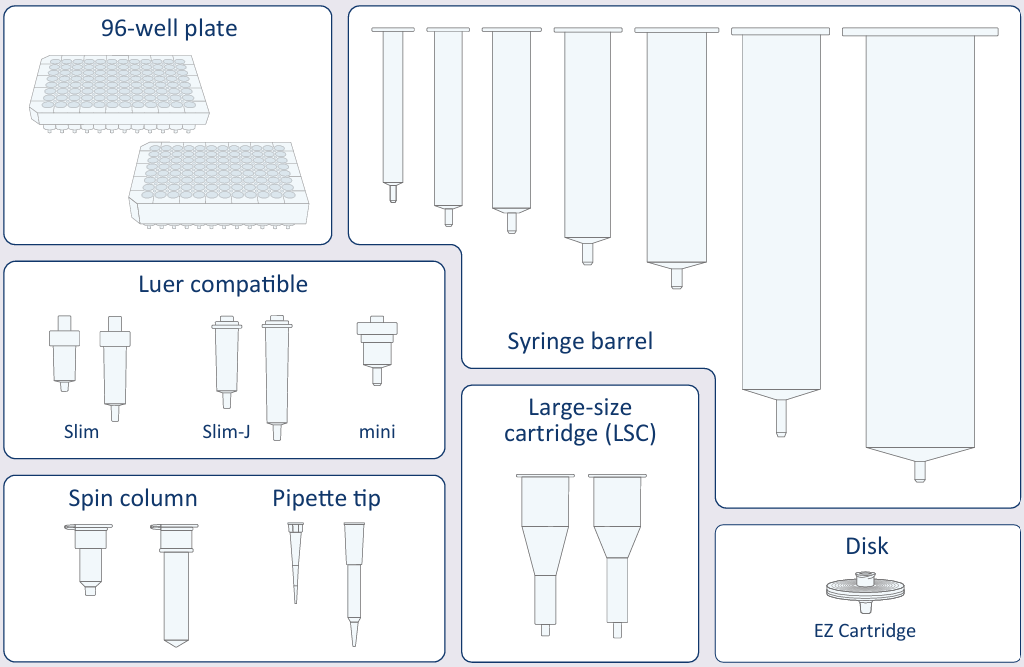
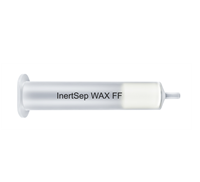
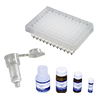
Common commercial formats include standard cartridges, disks, and 96-well SPE plates compatible with high-throughput analysis (standard 96-well footprint).