






 Environment &
 Food & Beverage
 Cosmetics
 Life Sciences
 Petrochemical & General Chemistry
 Automotive Related & Interior Materials
6. Interactions Between Sorbents and Target Analytes
Retention in SPE is governed primarily by three types of interaction:
1) Non-polar (hydrophobic) interactions
2) Polar interactions
3) Ion-exchange interactions
6-1. Reversed-Phase Sorbents & Non-Polar Interactions
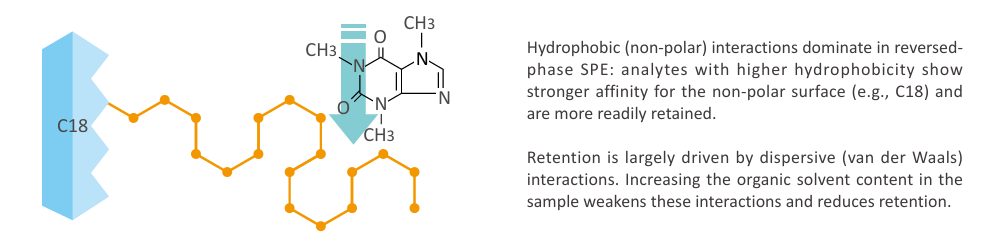
Silica-based reversed-phase sorbents are available with different bonded groups—C2, PH (phenyl), CH (cyclohexyl), C8, C18, etc. As carbon loading increases, sorbent hydrophobicity increases and retention of hydrophobic compounds becomes stronger. When both the analyte and matrix are of low polarity, selectivity derived solely from hydrophobic interactions can be limited. For very hydrophobic analytes, shorter-chain phases such as C2, PH, or CH can improve selective separation from the matrix. Hydrophobic interactions are strengthened in aqueous matrices, enhancing retention; conversely, the presence of
polar organic solvents (methanol, acetonitrile) suppresses retention and must be controlled.
6-2. Normal-Phase Sorbents & Polar Interactions
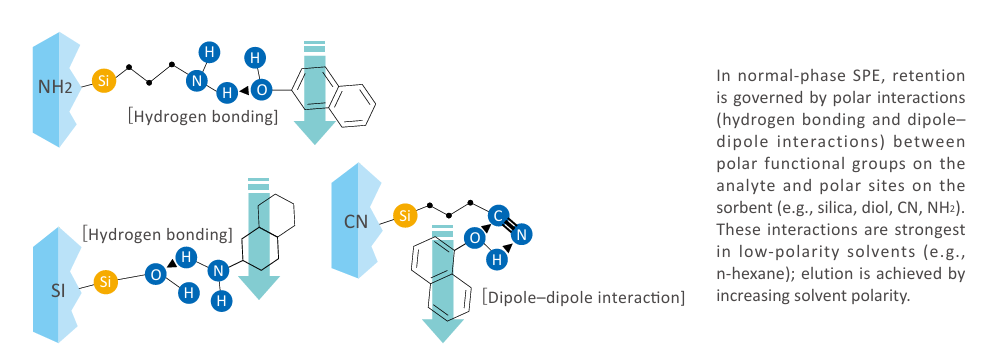
Polar interactions are enhanced in low-polarity solvents such as n-hexane. In polar solvents, polar interactions are greatly reduced in polar solvents, even when a suitable sorbent is selected for polar analytes with a suitable sorbent choice. For elution, passing a polar solvent through the sorbent weakens these interactions and releases the analyte.
6-3. Ion-Exchange Sorbents & Ion-Exchange Interactions
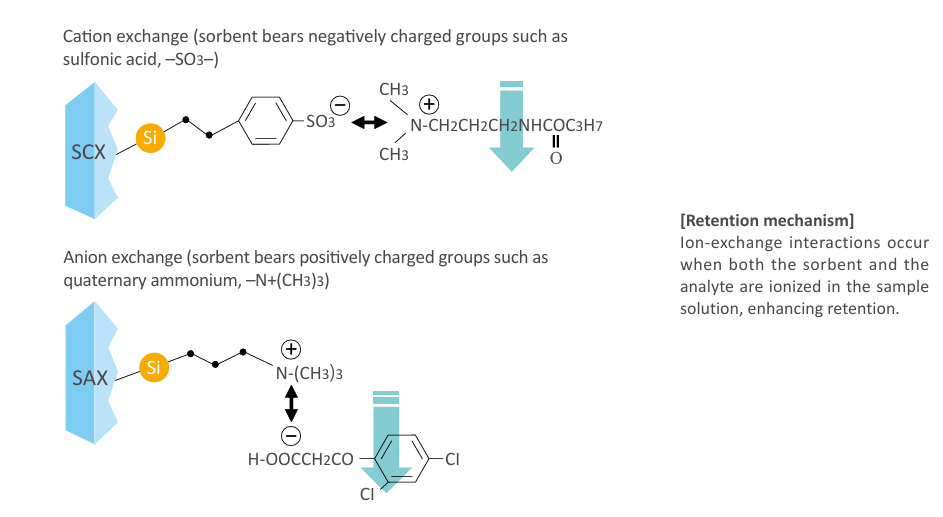
When the analyte is ionized under given conditions, ion-exchange interactions arise. Because ion-exchange retains only charged analytes, non-ionic interferences are largely excluded. Even if water-miscible organic solvents (e.g., methanol) are present in the matrix, ion-exchange interactions occur as long as the analyte is ionized. Note, however, that high salt concentrations can suppress ion-exchange interactions.