




 Environment &
 Food & Beverage
 Cosmetics
 Life Sciences
 Petrochemical & General Chemistry
 Automotive Related & Interior Materials
8. General SPE Operating Procedure
SPE is typically performed in four steps. Below are general guidelines by sorbent type. Always verify and optimize for the actual test conditions.
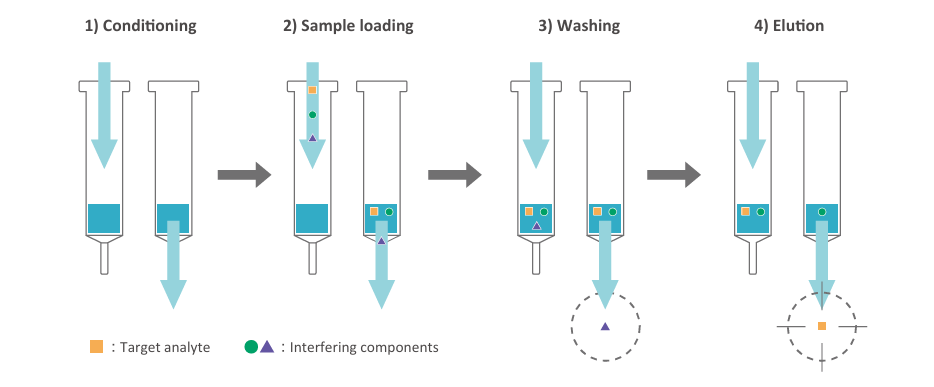
8-1. Conditioning (Activating the Sorbent)
Reversed-phase (polymer, C18, etc.) — Guidelines:
•If ethyl acetate or dichloromethane (DCM) will be used for elution, first pass 1 RV of that solvent, followed by 1 RV of methanol. If the eluent base is methanol or acetonitrile, pass 1 RV of the same. (For compatible cartridges, pass 6 mL.)
•Follow with the same volume of water to exchange the solvent. If residual MeOH/ACN adversely affects retention, pass twice that volume of water.
•For borderline retention conditions, pre-equilibrate with a buffer at the matrix pH to improve retention.
•With silica-based RP phases (e.g., C18), trace metals may chelate certain analytes; pre-flush with 1 mol/L EDTA solution to prevent this.
•For very weakly retained acidic/basic analytes, adding an ion-pairing reagent can promote retention. Pre-flush the sorbent with the ion-pair solution as well.
Normal-phase (Si, FL, etc.) — Guidelines:
•Pass 1 RV of a low-polarity solvent such as n-hexane. (compatible: 3–6 mL.)
Mixed-mode / Ion-exchange — Guidelines:
•Pass 1 RV methanol. (compatible: 3–6 mL.)
•Then pass the same volume of water. (For CBA, WCX, MC-2, it may be effective to pass 1 RV of 2% formic acid first, then the same volume of water.)
•If needed, pass pH 6–7 buffer (same volume) to pre-adjust to the matrix pH.
Terminology: 1 RV (one reservoir volume) = the nominal volume of the cartridge reservoir.
8-2. Sample Loading (Retaining the Analyte)
Reversed-phase (polymer, C18, etc.) — Guidelines:
•Neutral analytes (e.g., aromatic esters) generally show high affinity and are retained with little pH dependence.
•To retain ionizable acidic or basic analytes efficiently, adjust the matrix pH to convert them to the neutral (unionized) form.
Use pKa as a guide.
Note: Even in the neutral form, analytes without sufficient hydrophobic structure will not retain.
•Polar organic solvents (MeOH, ACN, acetone) in the matrix suppress retention in a concentration-dependent manner. Highly hydrophobic analytes may still retain at ~20% organic, but more polar analytes may break through. Dilute with water/buffer to ≤10% organic, or remove organic solvent by evaporation before loading.
•For serum/plasma, dilute with an equal or double volume of water or buffer prior to loading.
•Highly water-soluble acids/bases can be difficult to retain. Add ion-pairing reagents before loading: Acids — tetrabutylammonium bromide (TBAB), cetyltrimethylammonium chloride (CTAC); Bases — sodium hexanesulfonate, sodium pentanesulfonate.
Normal-phase (Si, FL, etc.) — Guidelines:
•Applicable to polar analytes with –OH/–NH groups; the matrix must be low-polarity (e.g., n-hexane).
•In pesticide-residue analysis using Si/FL, when acetone–n-hexane is used as the loading solvent, >5% acetone can reduce retention for some pesticides; adjust accordingly.
•Some polar analytes are insoluble in n-hexane. First dissolve in DCM or ethyl acetate, then gradually mix with n-hexane to lower polarity before loading.
Mixed-mode / Ion-exchange — Guidelines:
•Both the sorbent and the analyte must be ionized (appropriate charge states) for retention—confirm pKa values and set conditions correctly.
•If the sorbent–analyte pairing is inappropriate, the analyte may not retain or may be too strongly retained to elute.
8-3. Washing (Removing Matrix Interferences)
Reversed-phase (polymer, C18, etc.) — Guidelines:
•Wash with 1–2 RV of water to remove highly polar interferences. (For Luer-compatible cartridges, 3–6 mL is typical.)
•If analyte leakage occurs during water wash, switch to a buffer at the matrix pH or a dilute acid/base adjusted to the same pH as the loading conditions.
•For heavily contaminated matrices, water alone may be insufficient. Wash with ~5–30% methanol in water (1 RV). Optimize the %MeOH empirically based on analyte retention.
•If the analyte is insoluble in n-hexane or ethyl acetate, these can serve as wash solvents—first dewater the cartridge by vacuum for ~3 min.
Normal-phase (Si, FL, etc.) — Guidelines:
•Wash with 1–2 RV n-hexane. (Slim / Slim-J: 3–6 mL.)
•To increase washing strength, use n-hexane with an appropriate amount of a polar modifier (e.g., acetone).
Mixed-mode / Ion-exchange — Guidelines:
•Wash with water.
•Then wash with 100% methanol (use 50% methanol if ion-exchange interactions are weak).
8-4. Elution (Recovering the Analyte)
Reversed-phase (polymer, C18, etc.) — Guidelines:
•In food and drug analyses, use methanol or acetonitrile. Typical elution volumes (vary by cartridge size and sorbent):
Polymer sorbent — 30 mg/1 mL → minimum 0.2 mL; 270 mg/6 mL → ~5–10 mL. Silica-based RP — 100 mg/1 mL → min. 0.5 mL; 500 mg/3 mL → ~3–5 mL.
•For basic analytes on silica-based RP, recovery may be poor due to residual silanol adsorption. Eluting with methanol containing 2–4% (v/v) concentrated ammonium hydroxide (aq.) can markedly improve recovery.
•Depending on analyte solubility, n-hexane, toluene, ethyl acetate, or DCM can be used. Dehydrate the cartridge before elution to avoid water carryover into organic eluents.
Normal-phase (Si, FL, etc.) — Guidelines:
•Elute with polar solvents such as acetone or methanol.
•For more selective elution, use hexane/ethyl acetate with a suitable proportion of acetone or methanol as a modifier.
Mixed-mode / Ion-exchange — If evaporating eluates to dryness leaves salts that would interfere with analysis:
•Weak cation exchange (WCX): 10–20 mmol/L HCl in methanol, or methanol containing 2–4% (v/v) concentrated ammonium hydroxide (aq.).
•Strong cation exchange (SCX): methanol containing 2–4% (v/v) concentrated ammonium hydroxide (aq.).
•Anion exchange (for acids with –COOH retained on an AX phase): 10–20 mmol/L HCl in methanol, or methanol containing 2–4% (v/v) concentrated ammonium hydroxide (aq.).
•Weak anion exchange (WAX) for strong acids with –SO3⁻ (sulfonates): methanol containing 2–4% (v/v) concentrated ammonium hydroxide (aq.).
Mixed-mode / Ion-exchange — If residual salts after evaporation do not affect the analysis:
•Strong cation exchange (SCX) for basic analytes: use ≥0.5 mol/L ammonium chloride, ammonium acetate, ammonium formate, potassium chloride, or potassium dihydrogen phosphate aqueous solutions; add methanol or acetonitrile as needed.
•Anion exchange (for acids with –COOH): use 0.07–1.0% phosphoric acid in methanol, ≥0.5 mol/L ammonium chloride in acetonitrile, or ≥0.5 mol/L citric acid in methanol.
•Weak anion exchange (WAX) for strong acids with –SO3⁻: use ≥0.5 mol/L ammonium chloride in methanol or ammonium chloride in acetonitrile.